Conference Connection – How We Bond with Our Writers’ Tribe

Alice Orr Books at Liberty States Conference Conference Connection. How We Bond with Our Writers’ Tribe. I am just now emerging from the fog of a writers’ conference. Why a fog? Because that’s what the misty airlock feels like between conference world and my daily world. A sweet fog of adjustment before re-entry. Why sweet? That is a more complicated question. The sweetness of the fog is a carryover from the sweetness of the experience and the many nectars of its ingredients.

We leave our daily world behind. This is the essential first step toward making the Conference Connection. My personal sweetness recipe begins with the hotel stay. I’ve long maintained that room service and maid service are among the supreme triumphs of this or any culture, with the twenty-four-hour lobby snack corner running a close third.

We open up from our solitary selves. Writing is a self-on-self pursuit. We sit in a room and commune with our muse. As fiction writers, we converse with folks who only exist inside our heads. Sometimes we stare at the wall, and we do it all alone. Thus, we can become a bit in-grown. Like musty bedding, we require occasional airing to remain fresh. There are few more refreshing opportunities for a writer than making a Conference Connection.

We fall in among our Tribe. Which brings us to the sweetest ingredient of conference ambrosia. Writers, writers, and more writers. In corridors and workshops. At informal get-togethers and more formal ones. Talking, laughing, debating, sharing. Writers everywhere, on furlough from the trenches, encouraging one another to fight through the obstacles we all inevitably encounter. This is the beating heart of the Conference Connection, and it is Us.

We celebrate ourselves and one another. My entrée into Liberty States Fiction Writers Conference 2018 was an impromptu gathering in the hotel lounge. I had been invited to join by my old friend, Sandra Barone. She introduced me to Christine Akins Clemetson, who immediately became my new friend, as often happens at writers’ gatherings. Christine had huge news to share. She’d just signed with a literary agent. Joy and wonder shone from her slightly dazed smile, encouraging and inspiring us all with a magical Conference Connection.

We learn. We learn. We learn. From workshops, keynote talks, forums and, most of all, each other. Author, teacher, maven Chris Redding took time from her busy day to share her marketing expertise. Amazon algorithms are incomprehensible to me, but Chris pierced that darkness with enough light to set me on a more fruitful track. She also reminded me of my own mantra, Do It Anyway! She didn’t have to bother with any of that, but she did it anyway. Such generosity is the gold which is mined for each of us when we make a Conference Connection.
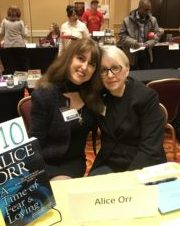
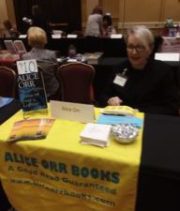
We Book Fair. Book signings can be humiliation hell. I once signed next to Nora Roberts. R for Roberts, O for Orr and OMG. The Ps and Qs knew enough to stay away. But at Liberty States, the O section sat me with long-time author friend L.G. O’Connor. Sweet indeed. Because book signings can be heaven.

We know that these events aren’t about selling books. These book signings are about being there, showing up, sitting behind a propped-up copy of your latest publication. Or dreaming of the day when you’ll have a propped-up copy of your own to flaunt. Either way, we smile ear-to-ear and heart-to-heart amidst our tribe, linked to one another by our Conference Connection.

Is there a downside? Maybe the case of Crammed-Brain Syndrome many of us take with us from hours and days of workshops and panels. Or the soft brace you wear on your wrist after scribbling like crazy in your notebook to capture every morsel of information. But we can handle that and then some, in return for establishing a Conference Connection.

We re-enter our individual writers’ lives better off for the experience. We have shown our shining faces to the writing world. We have hugged old friends and discovered new ones. We have been embraced by the spirit of our community and participated in a powerful ritual of our tribe. Plus, last but far from least, we’ve had fun.

So, here I am, post-fog. I made another solid Conference Connection, and, best of all, I bonded yet again with how blessed I am to do this writer thing.                                                 Alice Orr – https://www.aliceorrbooks.com

– R|R

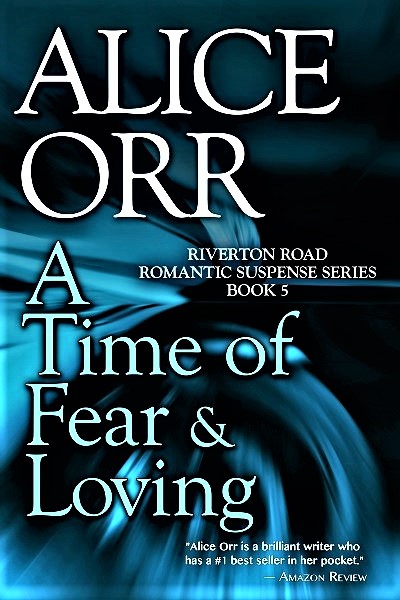
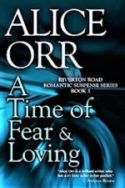
A Time of Fear & LovingConference Connection and her writers’ tribe have a lot to do with Alice’s joyful experience of her career and her novels. Don’t miss her latest, A Time of Fear & Loving – Riverton Road Romantic Suspense Book 5. Available HERE. Look for all of Alice’s books HERE.

 What readers are saying about A Time of Fear & Loving. “I never want an Alice Orr book to end.” “Alice Orr is the queen of ramped-up stakes and page-turning suspense.” “Warning. Don’t read before bed. You won’t want to sleep.” “The tension in this novel is through the roof.”
“A budding romance that sizzles in the background until it ignites with passion.”
“The best one yet, Alice!”

http://facebook.com/aliceorrwriter/
http://twitter.com/AliceOrrBooks/
http://goodreads.com/aliceorr/
http://pinterest.com/aliceorrwriter/
Create Captivating Characters – How to Heart-Hook Your Reader

Create Captivating Characters. This is what all writers want to do. No doubt about it. The doubt arrives when we come to the How. How do we Create Captivating Characters to inhabit our stories? How do you make them inhabit your story?

Success for the storyteller is all about the characters you create. I’ve said that already in my last post, “Tell Strong Stories – How To Write a Great Main Character.” This is especially true for the storyteller of commercial fiction. The writer who must attract readers in large numbers.

We must Create Captivating Characters who possess the storytelling power to enthrall those readers. These characters captivate because our readers care about what happens to them. Before we explore how, specifically, to make that caring occur, let’s pin down your basics.

If you’re working on a novel now, where are you in that process? Are you at the beginning? If not, let’s imagine you are – either at the beginning or near it. Let’s put Beginner’s Mind to work for us and start from scratch as we explore how to Create Captivating Characters.

First of all, do you have a single, specific Main Character? Most successful stories have one main character. A first among equals who gives the story focus. Reader interest and agent-editor interest are best captured by a single, strong protagonist.

Have you named your single, strong protagonist? Give your main character a name up front, when you begin creating the story. Naming gives characters substance and reality, especially in your own consciousness as their creator. Even though that character name may change later.

If you are not working on a novel now, choose a character from someone else’s story. Use that character for the exercise to come in this post. Feel free to change that character from the original author’s version. My personal choice would be Scout Finch, daughter of Atticus, in To Kill a Mockingbird by Harper Lee.

Why is a strong main character so important? Because when we read about his joys, his hopes and dreams. When we witness his admirable qualities in practice, or sometimes the qualities we less readily relate to, as with Jay Gatsby in The Great Gatsby by F. Scott Fitzgerald, we recognize that this character has something important to lose.

We don’t want this strong main character to lose this important thing. The strength of his portrayal has invaded our imaginations. We identify with him as the valiant person we wish to be. We identify with what happens to him. We’ve been hooked in the heart because we care.

The more we care what happens to your character, the more solidly your story hook is set in us. You are succeeding most spectacularly as a storyteller when you create a character whom we will care about not just a little, but intensely. The way we care about, even weep for, Celie in The Color Purple by Alice Walker.
Make us care about your character, then make us care even more. Start by answering this question for your main character, or the character you are working with today. What, specifically rather than in general, makes us care about this character as she is currently portrayed?

Now, what can you add to that portrayal to make us care even more about her? You have created a character we already care about. We are emotionally tied to her fate. We hope for only good things to happen to her. To make us care even more, you must frustrate our hopes for her.

You must make bad things happen to this character we are growing to love. Circumstances must block her from what she needs. Circumstances that are scary for her must arise. Physically scary and emotionally scary obstacles must explode onto her path.

In other words, you must put your main character into Trouble and Danger. You must make her fate uncertain, preferably perilous. Put her on a roller coaster ride. Most crucial to your success as a storyteller, put us, as your readers, on this thrill ride with her.

Plunge your main character into hot water, then turn up the heat. You have made bad things happen to her, now you must make those bad things worse. Mercy is inappropriate here, no matter how much you have come to love her, as have the rest of us, your readers.

Intense, dramatic, powerful events make your character intense, dramatic and powerful. Trouble and Danger are intense, dramatic and powerful, especially when they inflict themselves upon someone you have made us care about – a lot.

This is the How – How to Create Captivating Characters. Intense, dramatic, powerful characters are Captivating Characters. They captivate us because we can’t take our eyes off them. We can’t take our hearts off them either. We care too much for that to be possible.

Create Captivating Characters and you will have us hooked. We will be hooked by your characters and by you as their author. We will prove how captivated we are by – drum roll please – buying your next book. And, that is something else all writers want. No doubt about it.  Alice Orr – https://www.aliceorrbooks.com

– R|R

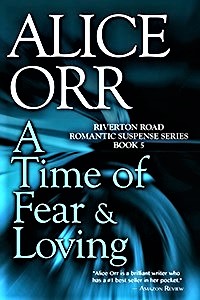
A Time of Fear & LovingAmanda Miller Bryce is a captivating character. Find out why in Alice’s novel A Time of Fear & Loving – Riverton Road Romantic Suspense Book 5. Meet Amanda HERE. You can find all of Alice’s books HERE.

What readers are saying about A Time of Fear & Loving. “I never want an Alice Orr book to end.” “Alice Orr is the queen of ramped-up stakes and page-turning suspense.” “Warning. Don’t read before bed. You won’t want to sleep.” “The tension in this novel is through the roof.”
“A budding romance that sizzles in the background until it ignites with passion.”
“The best one yet, Alice!”

http://facebook.com/aliceorrwriter/
http://twitter.com/AliceOrrBooks/
http://goodreads.com/aliceorr/
http://pinterest.com/aliceorrwriter/

Tell Strong Stories – How to Write a Great Main Character

Tell strong stories. That’s what every writer longs to do. What are strong stories anyway? To conquer an audience and make it your own you must tell a story that moves them. A story that moves them emotionally. Emotional Power is the impact your story must have.

The key to an emotionally moving storytelling is Character. The success of your story hangs on the strength of the main character you create and the way you employ that character as a storyteller. If your goal is to Tell Strong Stories your main character must move the narrative forward emotionally.

Why is your main character so important? Because your protagonist’s story is what connects you with the reader. You draw the reader in and make her care. That’s how you hook a reader. Mastering the art of the narrative hook is essential to writing a successful story.

You set that hook by creating a story in which the reader cannot help but become emotionally involved. First and foremost you do this by creating a character with whom the reader cannot help but become emotionally involved.

Which means that the reader must care about what happens to your character. The reader must begin to behave as if the Protagonist of your story were a real-life person they know personally. Your character’s defeats are the reader’s defeats. Your character’s triumphs are the reader’s triumphs.

When you make your readers feel this connection you have them hooked. And they will stay hooked from beginning to end.

[For example, I was hooked by both Rick and Ilsa in the film Casablanca and wanted both of them to triumph. The conclusion turned out to be more complicated than that, which hooked me deeper still. Those screenwriters knew how to Tell Strong Stories.]
Here’s how to begin creating characters as real as Rick and Ilsa.

#1. First, the character must hook you. You as author must be as emotionally involved with your character as you want the reader to be.

#2. Which requires that you as author must know your character intimately. You must know your characters – especially your main character heroine or hero – from the Inside Out. Which means you must understand as deeply as you possibly can what it’s like to be your protagonist.

Why do you need to know so much about your protagonist? In practical terms, you must know enough to keep your readers reading. You need to know a lot about a character to make her sufficiently complex to carry the weight of your story from the beginning to the end of a book.

You must know enough about this character to bring him to life on the page and make the reader care about him.

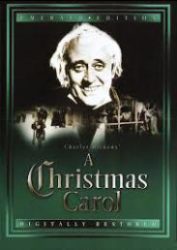
[For example, Charles Dickens brought Ebenezer Scrooge to life on the page in A Christmas Carol, and made us care what happened to him as well. Dickens knew Scrooge from the Inside Out.]

Here’s an exercise for getting to know your character from the Inside Out. Project yourself into your main character. Become your main character in your imagination. Then ask yourself the following five questions about that character.

#1. What does my main character want in this story? Is this desire significant enough to make a reader also want this thing for my character? Is this desire significant enough to make a reader want it for my character all the way through the length of an entire book? Or at some point does this desire pale into “Who cares?” territory for the reader?

#2. How much does my main character want this thing? Is this the most crucial need my character has ever experienced? Have I effectively communicated my character’s sense of urgency? How in specific scenes, action and dialogue can I turn up the story heat on the intensity of my main character’s desire?

#3. Why does my main character want this thing? Are her reasons – her motivations – admirable? Are these motivations logical in this story situation? Are her motivations believable to the extent that a reader will accept them as legitimate enough to motivate an intelligent, independent protagonist throughout the entire length of my story? Will a reader not only believe these motives but also adopt them on behalf of my character and root for her to achieve her desires?

#4. What does my main character not want? Is my character running away from something? If so, what is it and why is he on the run from it? Is my character avoiding something? If so, what is he avoiding and why? What is my character afraid of? Why is my character afraid of this thing?

[Here’s another way to Tell Strong Stories in terms of drama, intensity and power. Make sure every character fears something. Especially your main character. For example, what does Scarlett O’Hara fear in Margaret Mitchell’s Gone with the Wind?]
#5. What’s at stake for my main character in this story situation? What will happen if she fails to achieve what she wants or needs? Are those consequences dreadful enough to make a reader dread them as well? Who in my story besides my main character could also be adversely affected? How in specific scenes, action and dialogue can I intensify these stakes by making the potential consequences more devastating, pervasive and far-reaching? In order to Tell Strong Stories you must raise the stakes as high as your story will allow.

Brainstorm every possible response to each of these questions. Always push yourself beyond the first, most obvious possibility toward less expected, more original ones. The farther reaches of our imaginations are the place from which we Tell Strong Stories.

Alice Orr – https://www.aliceorrbooks.com

– R|R

Amanda Miller Bryce is the main character of the strong story that is Alice’s new novel A Time of Fear & Loving – Riverton Road Romantic Suspense Book 5. Meet Amanda HERE. You can find all of Alice’s books HERE.

What readers are saying about A Time of Fear & Loving. “I never want an Alice Orr book to end.” “Alice Orr is the queen of ramped-up stakes and page-turning suspense.” “Warning. Don’t read before bed. You won’t want to sleep.” “The tension in this novel is through the roof.”
“A budding romance that sizzles in the background until it ignites with passion.”
“The best one yet, Alice!”

http://facebook.com/aliceorrwriter/
http://twitter.com/AliceOrrBooks/
http://goodreads.com/aliceorr/
http://pinterest.com/aliceorrwriter/